What is Hydrogen Peroxide?
Hydrogen peroxide (H₂O₂) is a colorless liquid at room temperature with strong oxidizing properties. It is widely used as a bleach and disinfectant. Low-concentration solutions are used for household purposes, such as whitening clothes or disinfecting minor wounds.
Chemical Structure:
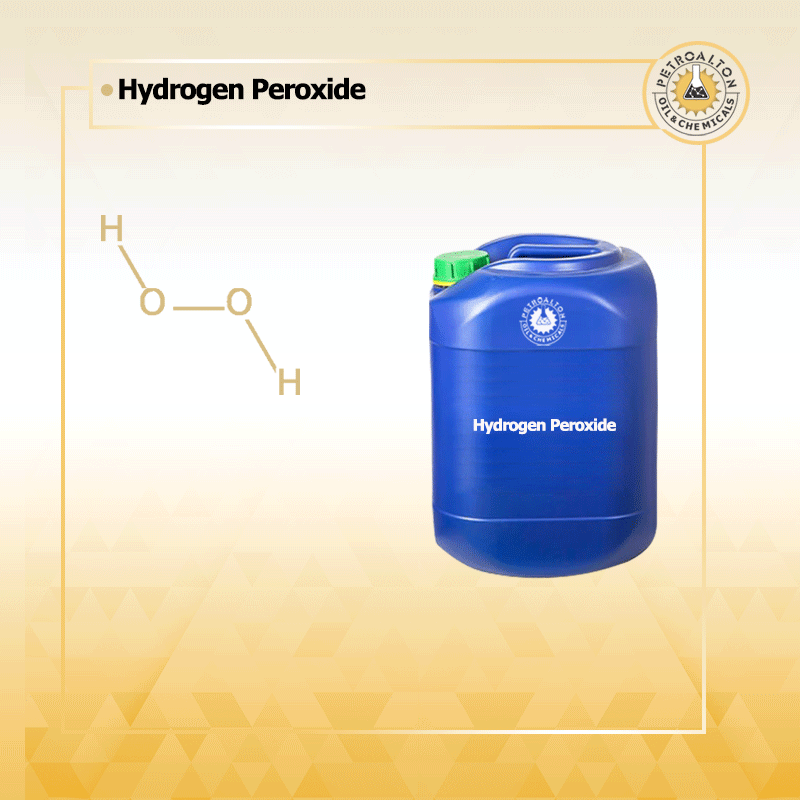
Hydrogen peroxide is one of the simplest peroxides. Its molecule consists of two hydroxyl groups connected by a single oxygen–oxygen covalent bond.
Properties:
- Molecular formula: H₂O₂
- At the molecular level, it contains two hydrogen and two oxygen atoms.
- It can rapidly decompose into water (H₂O) and oxygen (O₂), a reaction that can be explosive at high concentrations or under improper handling.
Due to its strong oxidizing power, hydrogen peroxide is used in medical, dental, agricultural, water treatment, and livestock industries as a disinfectant and chemical reagent. Handling requires caution, as it can cause chemical burns or severe internal damage if ingested.
Market Overview
The demand for hydrogen peroxide grows continuously due to its wide industrial applications, particularly in cosmetics, pharmaceuticals, agriculture, and food processing. Prices depend on quality, production methods, and supply sources. PetroAlton provides high-quality H₂O₂ at competitive prices to meet market needs.
Commercial Concentrations:
- 3%: Household disinfectant and wound care
- 3–12%: Hair bleaching in salons
- 30%: Laboratory experiments and chemical reactions
- 30–35%: Cleaning electronic devices, hand disinfection
- 35%: Neutralizing chlorine in water
- 35%–50%: Food industry applications
- 90%: Oxygen source for chemical processes, rocket fuel
Grades of Hydrogen Peroxide
- Industrial Grade:
- Concentration: 35–90%
- Used widely in various industries. Industrial-grade H₂O₂ may contain harmful heavy metals and stabilizers; storage requires special precautions.
- Food Grade:
- Available in 35% and 50% concentrations.
- Used in the food industry; production costs are high.
- Laboratory Grade (Reagent):
- Usually 37% concentration for scientific research.
- Cosmetic Grade:
- 3–12% concentration, used in hair dyes, dental whitening, and cosmetic products.
- Pharmaceutical Grade:
- 3% concentration, used in antiseptic solutions and household disinfectants.
Applications of Hydrogen Peroxide
Agriculture:
- Soil disinfection: Eliminates harmful fungi and bacteria.
- Enhancing oxygen in irrigation water: Improves root growth in hydroponics.
Medical & Hygiene:
- Disinfectant for minor wounds and cuts.
- Mouthwash ingredient for reducing bacteria and bad breath.
- Sterilizing medical and dental instruments.
- Earwax removal in low concentrations.
Cosmetics & Personal Care:
- Hair bleaching and coloring.
- Nail whitening.
- Mild skin cleansing in certain products.
Livestock & Poultry:
- Disinfecting drinking water.
- Sanitizing facilities, surfaces, and equipment.
- Reducing ammonia odors.
- Supporting disease control under veterinary guidance.
Oil, Gas & Petrochemical Industries:
- Removal of hydrogen sulfide (H₂S) and mercaptans.
- Treating polluted water and soil.
- Controlling microbial growth in drilling fluids.
- Oxidation reactions in chemical manufacturing (e.g., propylene oxide, caprolactam, phenol, and acetone).
- Producing peracids and other oxidizing chemicals.
Textile Industry:
- Bleaching cotton, wool, silk, and other fibers.
Pulp & Paper Industry:
- Whitening pulp for high-quality paper production.
Water & Wastewater Treatment:
- Oxidizing organic and inorganic pollutants.
- Controlling odors.
- Disinfecting water.
Food Industry:
- Sterilizing food packaging.
- Improving the appearance of food ingredients such as flour, oil, and starch.
Household Use:
- Removing stains (blood, grass, etc.).
- Whitening clothes as a chlorine-free alternative.
- Cleaning and disinfecting surfaces.
Production Methods of Hydrogen Peroxide
- Traditional Anthraquinone Process:
- Hydrogenation: Anthraquinone is hydrogenated to anthrahydroquinone.
- Oxidation: Anthrahydroquinone reacts with oxygen to regenerate anthraquinone, producing H₂O₂.
- Extraction & Purification: H₂O₂ is separated and purified.
- Pros: Proven process, high-scale production.
- Cons: Complex, energy-intensive, generates chemical waste.
- Modern, Environmentally Friendly Methods:
- Direct synthesis from elements (oxygen and hydrogen).
- Electrochemical processes.
- Advantages: Cleaner, safer, less waste.