Industrial Acetone Purchase and Sales
Petro Alton Tajhiz Company, as one of the leading suppliers of chemical solvents throughout Iran, offers industrial-grade acetone to its customers in the shortest possible time and with the highest quality.
For purchasing or ordering industrial acetone, obtaining the latest prices, and receiving the product datasheet, please contact our specialists at +98-21-59236.
What is Acetone?
Acetone is an inorganic compound that occurs naturally in body organs, muscles, tissues, and blood.
This colorless liquid chemical is the smallest and simplest member of the ketone functional group.
Discovered by Jim Wiseman, acetone is known in IUPAC nomenclature as propanone.
Key properties of acetone include its volatility, flammability, and excellent solvent capability.
Propanone dissolves easily in water, benzene, methanol, and diethyl ether.
Unlike most organic compounds, acetone mixes with water in all concentrations and is highly fluid.
Its molecular geometry is trigonal planar, and its density at 25 °C is 0.7845 g/cm³.
Acetone is an excellent solvent for nitrocellulose resins, cellulose acetate, cellulose ethers, most natural resins, polyvinyl acetate, polyacrylates, alkyd resins, and several other synthetic resins.
It also effectively dissolves fats, oils, and common plasticizers.
Chemical Formula of Acetone
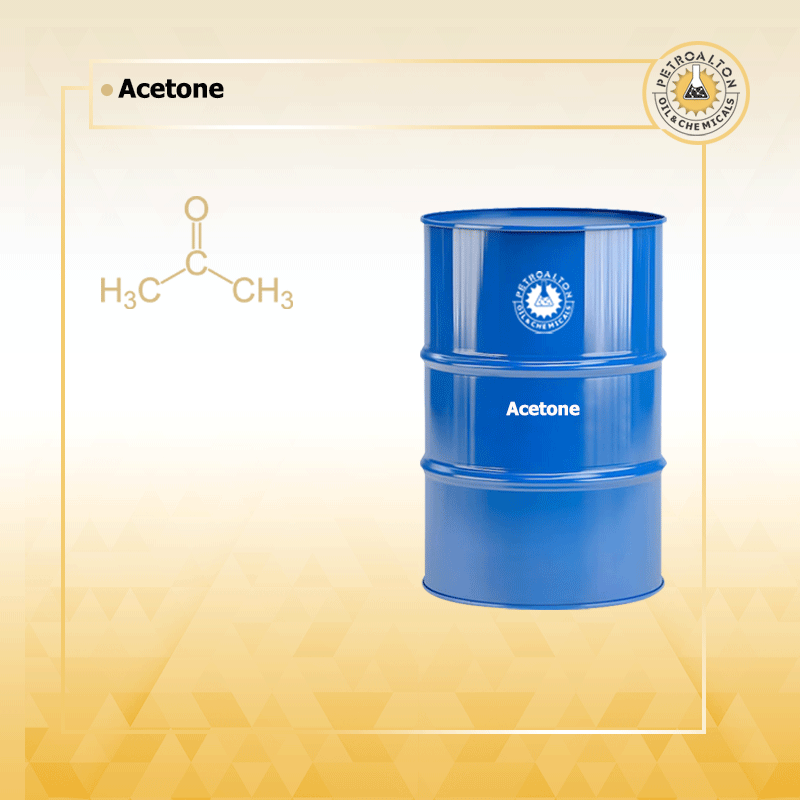
Acetone consists of 3 carbon atoms, 6 hydrogen atoms, and 1 oxygen atom, giving it the molecular formula C₃H₆O.
Factors Affecting the Industrial Price of Acetone (per drum)
- Quality and Purity
In the Iranian market, acetone quality and purity are key factors in determining its price.
High-purity acetone, used in pharmaceuticals and cosmetics, commands a higher price, while lower-purity grades are used in general industrial applications and are less expensive. - Source of Production (Domestic or Imported)
Acetone available in Iran may be locally produced or imported (mainly from China and European countries).
The price of imported acetone depends on exchange rates, customs duties, and import tariffs, while domestic acetone is generally cheaper due to lower production costs. - Purchase Volume
Bulk purchases are usually offered at discounted prices.
Petro Alton Tajhiz provides special discounts for large-scale buyers and industrial clients.
Small-quantity purchases typically cost more per unit. - Market Conditions and Supply–Demand Balance
When demand for acetone increases, prices typically rise accordingly. - Transportation Costs
Imported acetone generally incurs higher transportation costs due to freight charges and currency fluctuations. - Regulations and Standards
Government regulations and environmental or safety standards can increase production and transport costs, ultimately raising final prices.
Customs tariffs also affect imported acetone prices. - Currency Fluctuations
Because much of Iran’s acetone supply is imported, exchange rate fluctuations directly influence its market price.
Industrial Applications of Acetone
- As a Solvent
The most common use of acetone is as a solvent in various industries.
It is used to dissolve plastics, industrial bitumen, automotive and furniture paints, two-component epoxies, and polyester resins.
Due to its cleaning and degreasing properties, it also serves as a raw material for manufacturing industrial and household degreasers. - In Cosmetics and Personal Care (Nail Polish Remover Production)
Acetone is used in the cosmetic industry for nail polish removers, acne treatments, skin exfoliators, and salon equipment cleaners. - In the Pharmaceutical Industry
Acetone is used as a strong solvent in the synthesis of active pharmaceutical ingredients (APIs) and in formulating tablets, capsules, and injectable solutions.
It is also employed for purifying APIs and cleaning pharmaceutical equipment. - In Laboratory Applications
- As a solvent for organic reactions
- With ice to create a low-temperature reaction bath (ice–acetone bath)
- For cleaning laboratory glassware
- As a fluorescent tracer in experiments
- In methyl methacrylate production as an intermediate in the reaction between isobutyl alcohol and methyl isobutyl ketone
MSDS and Hazards of Industrial Acetone
Acetone is highly flammable and explosive when in contact with strong oxidizers such as acetic acid, nitric acid, and peroxides.
It can also react with chloroform and bromoform under basic conditions, leading to fire or explosion.
Dimethyl ketone (acetone) can corrode certain plastics.
Ingestion or inhalation can severely damage the respiratory system and lungs.
Inhalation irritates the nose and eyes, causing redness and burning.
Contact with skin may cause dryness and irritation; in such cases, wash the affected area with cold water and soap and apply a moisturizing cream.
Storage Conditions for Acetone
Due to its flammability, acetone should be stored away from heat, sparks, flames, and direct sunlight in sealed containers in a cool, ventilated area.
It must be kept away from bromine, chlorine, nitric acid, sulfuric acid, and chloroform due to chemical incompatibility.
Three Main Production Methods for Acetone
- Distillation of Calcium Acetate
Acetone is commonly produced by the dry distillation of calcium acetate. - Cumene Process
In the cumene process, benzene reacts with propylene to produce cumene, which is then oxidized by air to yield phenol and acetone. - Wacker–Hoechst Process
In this industrial process, propylene is directly oxidized with oxygen in the presence of a palladium catalyst to produce acetone.
Common Purity Grades of Acetone
Acetone is available in several purity grades to meet different industrial and laboratory requirements:
- Technical Grade (Industrial)
Purity: ~95–99%
Uses: General industrial applications, paint thinners, resin solvents, and cleaning agents. - Laboratory/Reagent Grade
Purity: 99.5–99.9%
Uses: Chemical reactions, analytical testing, and laboratory applications requiring high purity. - HPLC/ACS/Spectrophotometric Grade
Purity: ≥99.9% (up to 99.99%)
Uses: High-precision analytical techniques such as HPLC, GC, and spectroscopy, where minimal impurities are essential.
Always refer to the manufacturer’s Certificate of Analysis (CoA) to verify purity levels and ensure suitability for your specific application.
Major Global Manufacturers of Acetone
- France: Matron
- South Korea: Kumho
- Taiwan: CCP
Purchasing Kumho, Matron, and CCP Industrial Acetone
For up-to-date pricing and sales information on various acetone brands, please contact Petro Alton Tajhiz, a leading importer of chemical raw materials.